
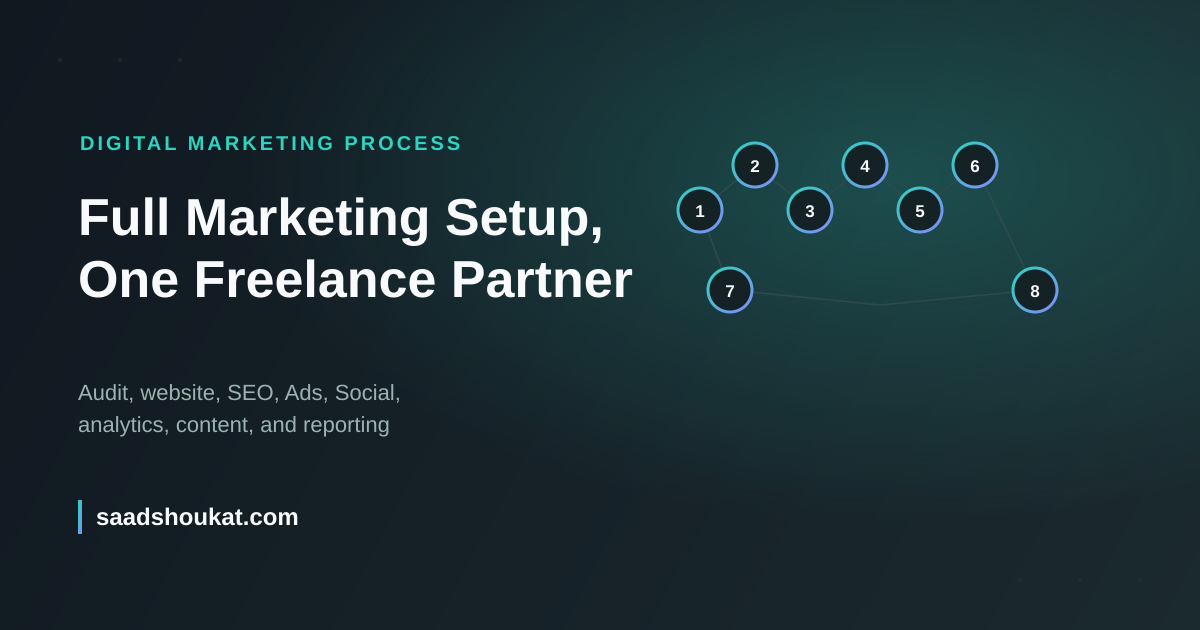
A complete digital marketing setup covers eight connected pieces: a technical foundation audit, the website, on-page and technical SEO, performance marketing through Google Ads and Meta Ads, social media management, analytics and tracking, content and local SEO, and ongoing reporting. Most businesses have some of these in place but not all of them working together, which is where results get lost.
Business owners often come to me after hiring separate people for SEO, website work, ad management, social media, and content, only to find none of it is actually connected. One person manages ads, another posts on Instagram, a third writes blog posts, and nobody is tracking whether any of it leads to real leads or sales.
Here’s the exact process I follow when I take on a business’s full digital marketing setup as a freelance partner, whether I’m working directly with the business or delivering it under an agency’s brand.
Step 1: Foundation Audit
Before changing anything, I audit what’s already there:
- Website performance, hosting, and security
- Current SEO standing (rankings, indexing status, technical errors)
- Existing analytics and whether data is even being tracked correctly
- Current content and whether it matches what customers actually search for
This step exists for one reason: building new marketing on top of a broken foundation wastes money. I’ve seen businesses run ad campaigns pointing to a site that wasn’t even indexed properly.
Step 2: Website and WordPress Setup
The website is the hub everything else points back to. At this stage, I handle:
- A clean, fast WordPress setup or cleanup of an existing one
- Security basics (updates, backups, SSL, spam protection)
- Mobile responsiveness and page speed
- A structure that’s easy for both users and search engines to navigate
A slow or poorly structured website undermines every other marketing effort, no matter how good the SEO or ads are.
Step 3: On-Page and Technical SEO
With the foundation solid, I move into SEO:
- Keyword research based on real search intent, not guesswork
- On-page optimization: titles, meta descriptions, headers, internal linking
- Technical SEO: crawlability, indexing, schema markup, Core Web Vitals
- Increasingly, structuring content so it can also be cited in AI Overviews and AI search tools, not just rank traditionally
This is where most of the long-term organic visibility gets built.
Step 4: Performance Marketing — Google Ads and Meta Ads
SEO builds long-term visibility, but paid campaigns fill the gap while that’s being built, and scale what’s already working. At this stage, I handle:
- Google Ads: search campaigns, keyword targeting, negative keyword lists, and conversion-focused ad copy
- Meta Ads: Facebook and Instagram campaigns, audience targeting, and creative testing
- Proper conversion tracking (Google Ads conversion tags, Meta Pixel and Conversions API), so spend is tied to real leads or sales, not just clicks
- Budget structure and bid strategy based on what the account can realistically support, not guesswork
The biggest mistake I see is ad spend running without conversion tracking in place. Without it, there’s no way to know which campaigns or keywords are actually profitable, so the first thing I check before launching or taking over an account is whether conversions are being measured correctly.
Step 5: Social Media Management
Paid ads and SEO bring people in, but social media is where a business stays visible between purchases and builds trust. At this stage, I handle:
- A content calendar built around the platforms the business’s actual customers use, not every platform at once
- Consistent posting, so the account doesn’t go quiet for weeks between campaigns
- Community management: replying to comments and messages in a timely, on-brand way
- Keeping messaging consistent with the website and ad campaigns, so a visitor sees the same brand everywhere they encounter it
Social media rarely drives direct conversions on its own, but an inactive or inconsistent profile undermines trust right when a paid ad or search result sends someone to check the business out.
Step 6: Analytics and Tracking
Marketing without tracking is just guessing. I set up:
- Google Analytics 4, configured to track meaningful actions, not just pageviews
- Google Search Console, connected and monitored for errors
- Conversion tracking across organic traffic, paid campaigns, and social media referrals
- A simple dashboard so the business owner or agency can see what’s working without digging through raw data
Without this step, it’s impossible to know which marketing efforts, organic, paid, or social, are actually driving results.
Step 7: Content and Local SEO
Once the technical, paid, and tracking foundation is in place, I build visibility:
- Google Business Profile setup and optimization for local businesses
- Local citations and directory consistency
- A content plan built around real customer questions and search terms
- Ongoing content that supports both SEO rankings and AI search visibility, and gives paid campaigns and social posts better landing pages to point to
This step is where a business starts showing up consistently, not just occasionally ranking for one lucky keyword or running one ad campaign in isolation.
Step 8: Ongoing Management and Reporting
Digital marketing isn’t a one-time setup. I manage:
- Weekly progress updates: what was done, what’s next, what’s blocked
- Monthly reporting that covers SEO, ad spend, and social media performance together, tied to the goals defined at the start, not vanity metrics
- Continuous optimization: SEO adjustments, ad budget reallocation, social content tweaks, and keyword or creative testing based on what the data shows, not assumptions
This is also where the earlier scoping and documentation work pays off. A business always knows exactly what’s being done and why, across every channel.
Why One Freelance Partner Instead of Several Specialists
Most businesses don’t need five or six disconnected freelancers handling SEO, ads, social media, website work, and content separately. They need one person who understands how the pieces fit together, so the website, SEO, paid campaigns, social media, content, and tracking all point toward the same goals.
This is also why agencies bring me in as a white-label partner. Instead of hiring a full in-house team to deliver this across multiple clients, they get one dependable partner who delivers the complete setup under their brand, with the client never knowing the work was outsourced.
Frequently Asked Questions
What’s included in a full digital marketing setup?
A complete setup typically includes a technical audit, website and WordPress setup, on-page and technical SEO, performance marketing through Google Ads and Meta Ads, social media management, analytics and conversion tracking, content and local SEO, and ongoing reporting. Skipping any of these creates gaps that limit results.
Does social media management actually drive sales?
On its own, rarely. Social media works best alongside SEO and paid ads: it keeps a business visible and builds trust between purchases, so when a paid ad or search result sends someone to check the business out, an active, consistent profile reinforces that decision instead of undermining it.
Should a business run SEO and paid ads at the same time?
Yes. SEO builds visibility that compounds over months, while Google Ads and Meta Ads can generate leads immediately. Running them together, with shared conversion tracking, also shows which keywords and messaging convert best, which improves both channels.
How long does a full digital marketing setup take?
A foundation audit and website setup usually take 1 to 3 weeks, depending on the current state of the site. SEO and content building are ongoing processes that show meaningful results over 3 to 6 months.
Can a freelance partner really manage a full digital marketing setup alone?
Yes, when the partner has experience across WordPress development, technical SEO, analytics, and content strategy. The key is having one person who understands how all the pieces connect, rather than coordinating separate specialists who don’t communicate with each other.
How is this different from hiring an agency?
A freelance partner typically offers more direct communication, faster turnaround, and lower overhead than a full agency, while still covering the same scope of work. Many agencies also use freelance partners like this for their own clients’ overflow work.
Want This Set Up for Your Business?
I handle the full digital marketing setup, from technical audits and WordPress development to SEO, Google Ads and Meta Ads management, social media management, analytics, and ongoing reporting, either directly or as a white-label partner behind your agency’s brand.
Get a free digital marketing audit of your business → Contact Now!
