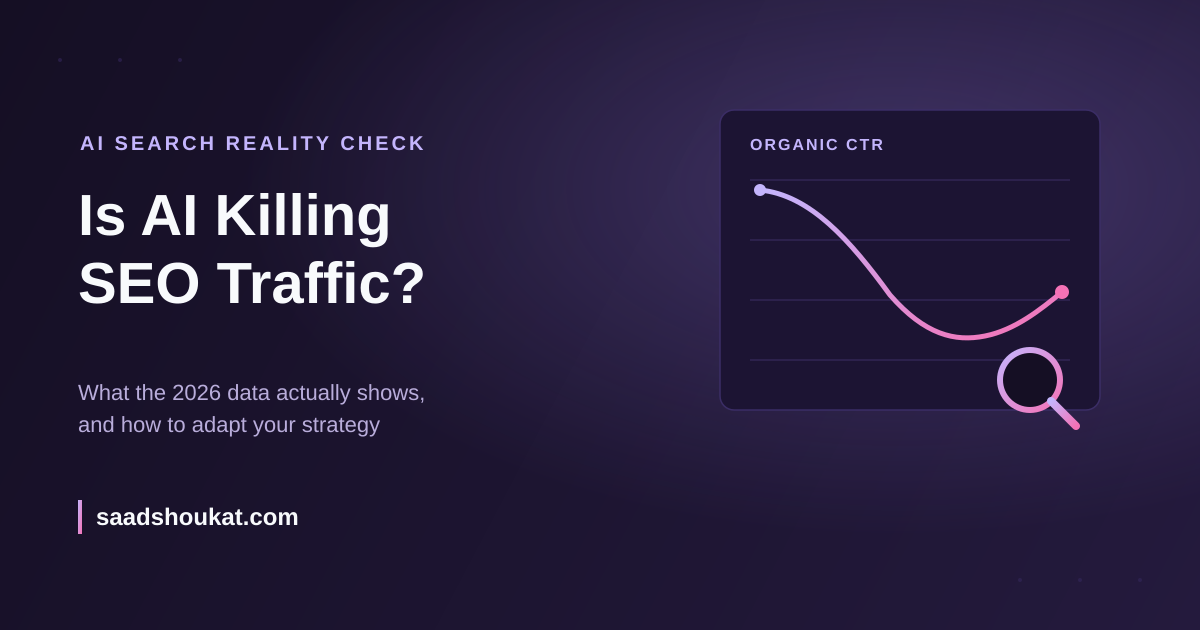
Short answer: No. AI is killing the easy informational click, not SEO itself. Clicks are down on many queries, but the picture is more nuanced than the headlines suggest, and the businesses that adapt are in a stronger position than the ones that panic.
If you run a business or an agency, you’ve probably heard “SEO is dead” a dozen times this year. Here’s what the research actually says, and what to do about it.
What the Data Says About Lost Clicks
The clicks are real, and pretending otherwise doesn’t help anyone.
- A randomized field study reported by Search Engine Journal in April 2026 found that Google AI Overviews reduced outbound organic clicks by 38% on the queries where they appeared, while zero-click searches rose from 54% to 72%. This is an early draft paper and has not yet been peer-reviewed, so treat the exact numbers with care.
- Pew Research found people clicked a traditional result about 8% of the time when an AI Overview was shown, compared with 15% when it wasn’t.
- Ahrefs analyzed 300,000 keywords and found that an AI Overview correlated with a 58% lower average click-through rate for the top-ranking page as of December 2025.
Different studies use different methods, so the exact percentage varies. The direction doesn’t: when an AI Overview answers the question, fewer people click.
What the Panic Misses
The story doesn’t end there. Three findings rarely make the headlines.
1. The decline has started to level off. Seer Interactive tracked 53 brands and millions of queries. Organic click-through on AI Overview queries bottomed out at 1.3% in December 2025, then recovered to 2.4% by February 2026.
2. Queries without AI Overviews are becoming more valuable. In the same dataset, click-through on queries with no AI Overview rose from 2.8% in early 2025 to 3.8% by February 2026. When AI handles the quick answers, the people who still click tend to want more depth.
3. Being cited matters. On results pages with an AI Overview, pages cited inside it get more clicks than pages that aren’t, according to Seer’s findings. Visibility inside the answer is now part of the game.
There is also early evidence that visitors arriving from AI platforms are more likely to convert than average organic visitors. Volume is still small, and much of this data comes from vendor studies, so it’s a signal to watch rather than a promise.
So What Is Actually Dying?
Not SEO. What’s dying is a specific playbook:
- Publishing thin “what is X” posts and expecting them to drive steady traffic
- Measuring success by rankings and clicks alone
- Treating technical SEO as optional because “content is king”
Simple informational queries are the most exposed. Deeper, decision-stage searches, where the person needs a specific provider, a real opinion, or a local option, still need a click.
What to Do Instead: A 5-Step Adaptation Plan
1. Fix the technical foundation first. AI systems and search engines can only cite what they can crawl, understand, and trust. Speed, clean indexing, and solid site architecture are the base for everything else.
2. Structure content for citation. Lead with the direct answer, use clear headings, and keep paragraphs short. Add FAQPage, HowTo, or Article schema so machines can read your content accurately.
3. Shift toward queries that still earn clicks. Target decision-stage and local-intent searches, plus topics where your experience adds something a generic summary can’t.
4. Build authority beyond your own site. Brand mentions, expert content, and consistent presence across the web all influence which sources AI systems trust.
5. Track more than rankings. Add AI visibility to your reporting: are you cited in Google AI Overviews, ChatGPT, and Perplexity for the queries your customers actually ask? Most businesses aren’t measuring this yet, which is exactly the opportunity.
What This Means for Agencies
If you run an agency, your clients are asking about this right now, and “SEO is fine” won’t satisfy them. They want a clear plan for how their visibility holds up in an AI-driven search landscape.
That means your delivery needs to cover technical SEO, content structure, schema, and AI visibility tracking, and it needs to happen without adding headcount. This is exactly the overflow work a white-label delivery partner can take on under your brand.
Frequently Asked Questions
Is AI really killing SEO traffic?
AI Overviews are reducing clicks on many informational queries, with studies estimating drops from roughly 38% to 58% depending on method. But click-through has partly recovered since late 2025, and queries without AI Overviews are performing better. SEO is changing, not disappearing.
What is a zero-click search?
A zero-click search is one where the user gets their answer directly on the results page and never visits a website. AI Overviews have increased how often this happens.
How do I get cited in Google AI Overviews?
Answer questions directly and early, use clear headings and structured data, keep your technical SEO strong, and build topical authority through expert content and mentions across the web.
Should I stop investing in traditional SEO?
No. Traditional SEO is the foundation that AI visibility is built on. The shift is toward adding structure, authority, and citation tracking on top of it, not abandoning it.
Not Sure Where Your Site Stands?
I help agencies and businesses adapt their WordPress and SEO strategy for AI search, from technical audits and schema implementation to content restructuring and AI visibility tracking, all delivered under your brand if you’re an agency.
Get a free SEO and AI search audit of your website → Contact Now!
