
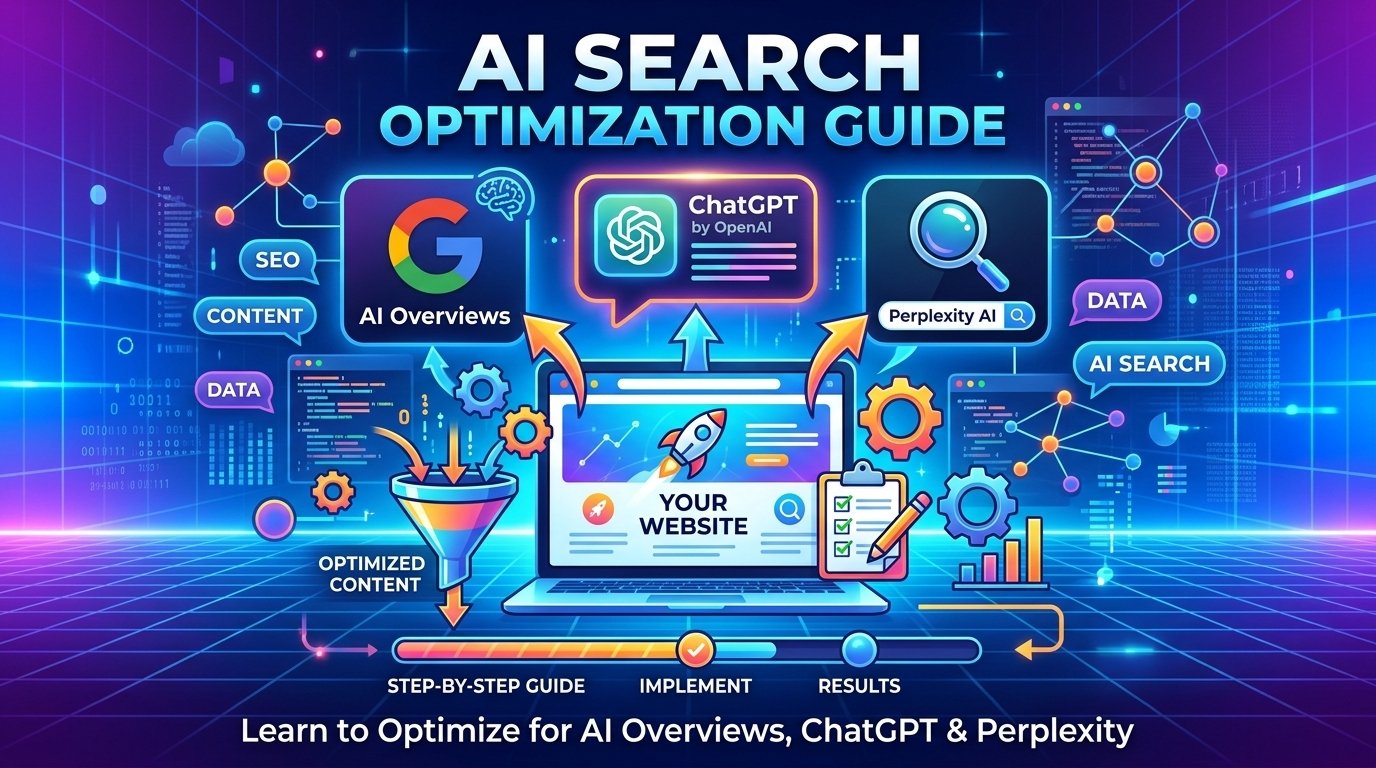
Search has changed more in the past two years than in the previous ten. Google AI Overviews now answer a large share of queries directly on the results page. ChatGPT, Perplexity, and Copilot are becoming first-stop research tools for millions of people. For website owners, this means one thing: ranking #1 on a traditional results page is no longer the finish line. Being cited inside the AI-generated answer is the new goal.
This guide covers what AI search optimization (sometimes called “Generative Engine Optimization” or GEO) actually means, how it differs from traditional SEO, and the concrete steps you can take today to improve your chances of being cited by AI Overviews, ChatGPT, and Perplexity.
What Is AI Search Optimization?
AI search optimization is the practice of structuring your website’s content so that AI systems, including Google’s AI Overviews, ChatGPT’s browsing and search features, and Perplexity can easily read, understand, extract, and cite it in their generated answers.
Unlike traditional SEO, where the goal is to earn a high-ranking blue link, AI search optimization aims to get your content:
- Extracted as a direct answer inside an AI Overview
- Cited as a source in a ChatGPT or Perplexity response
- Referenced by name, building brand visibility even without a click
Why AI Search Optimization Matters Now
A growing share of searches now end without a click, because the AI-generated answer satisfies the user directly. If your content isn’t structured to be picked up by these systems, you lose visibility even if you technically still rank well in traditional search.
At the same time, being cited by an AI Overview or a ChatGPT answer carries a trust signal of its own. Users increasingly treat AI-cited sources as vetted and credible, which can drive higher-quality traffic when clicks do happen.
How AI Search Differs From Traditional SEO
| Traditional SEO | AI Search Optimization |
|---|---|
| Optimizes for ranking position | Optimizes for being extracted and cited |
| Rewards backlinks and keyword density | Rewards clarity, structure, and topical depth |
| One long-form page can rank for many terms | Concise, well-labeled sections get pulled individually |
| Success measured by click-through | Success measured by citation and brand mentions |
Both approaches still rely on strong technical SEO, high-quality content, and authority. AI search optimization builds on top of good SEO rather than replacing it.
7 Practical Steps to Optimize for AI Overviews, ChatGPT, and Perplexity
1. Answer the Core Question in the First 2–3 Sentences
AI systems tend to extract the most direct answer available, often from the opening lines of a section. Avoid long introductions before getting to the point. State the answer clearly, then expand with context and detail afterward.
2. Structure Content for Extraction
Use clear, descriptive H2 and H3 headings that mirror how people actually ask questions (“How do I…”, “What is…”, “Why does…”). Keep paragraphs short. Use bullet points and numbered lists wherever a process or list of items is being explained. This structure makes it far easier for AI crawlers to isolate a clean, quotable answer.
3. Add Structured Data (Schema Markup)
FAQ schema, HowTo schema, and Article schema help AI systems understand exactly what a page covers and what questions it answers. Pages with clear schema markup are more likely to be surfaced accurately in AI-generated summaries.
4. Build Topical Depth, Not Just Keyword Coverage
AI models favor sites that demonstrate consistent, in-depth coverage of a subject over time, rather than isolated posts chasing individual keywords. Building a cluster of related, interlinked content around a core topic signals authority more effectively than one-off articles.
5. Strengthen E-E-A-T Signals
Experience, Expertise, Authoritativeness, and Trustworthiness remain central. Include author bios with real credentials, cite original data or first-hand experience where possible, and keep contact and business information clear and accessible. AI systems, like traditional search, weight credibility heavily when choosing which sources to cite.
6. Earn Mentions Beyond Your Own Site
AI models often cross-reference multiple sources, including forums, review platforms, and industry publications, not just your website. Getting mentioned on Reddit threads, industry roundups, and reputable third-party sites increases the likelihood that AI systems associate your brand with the topic.
7. Keep Content Fresh and Accurate
Outdated statistics, old pricing, or stale examples reduce the odds of being cited, since AI systems tend to favor recently updated, verifiably accurate content. Set a schedule to review and refresh key pages at least twice a year.
How to Check If You’re Already Being Cited
- Search your brand name alongside your core topic directly in ChatGPT or Perplexity to see if you’re referenced.
- Search your target queries on Google and check whether an AI Overview appears, and whether your site is among the cited sources.
- Monitor referral traffic in your analytics from ai.perplexity.ai, chat.openai.com, and similar sources, which indicates users arriving after an AI citation.
Common Mistakes to Avoid
- Burying the answer under long introductions or storytelling before getting to the point.
- Ignoring schema markup, which leaves AI systems to guess at your page’s structure.
- Chasing keyword density instead of genuinely answering the underlying question.
- Letting cornerstone content go stale, which reduces trust signals over time.
Frequently Asked Questions
Does AI search optimization replace traditional SEO? No. It builds on the same technical foundation — site speed, mobile-friendliness, backlinks, and quality content — while adding a layer of structure aimed at extraction and citation.
Can small websites get cited by AI Overviews or ChatGPT? Yes. Citation depends more on clarity, structure, and relevance to the specific question than on domain size alone, though overall authority still helps.
How long does it take to see results from AI search optimization? Similar to traditional SEO, expect a gradual improvement over 2–4 months as AI systems recrawl and reassess site content, rather than an immediate shift.
Final Thoughts
Ranking on page one used to be enough. Now, the real goal is showing up inside the answer itself, whether that’s a Google AI Overview, a ChatGPT response, or a Perplexity summary. The websites that adapt their content structure now, while most competitors are still optimizing purely for traditional rankings, will have a meaningful visibility advantage over the next few years.
Need help auditing your website for AI search visibility? Get in touch for a free assessment.
