
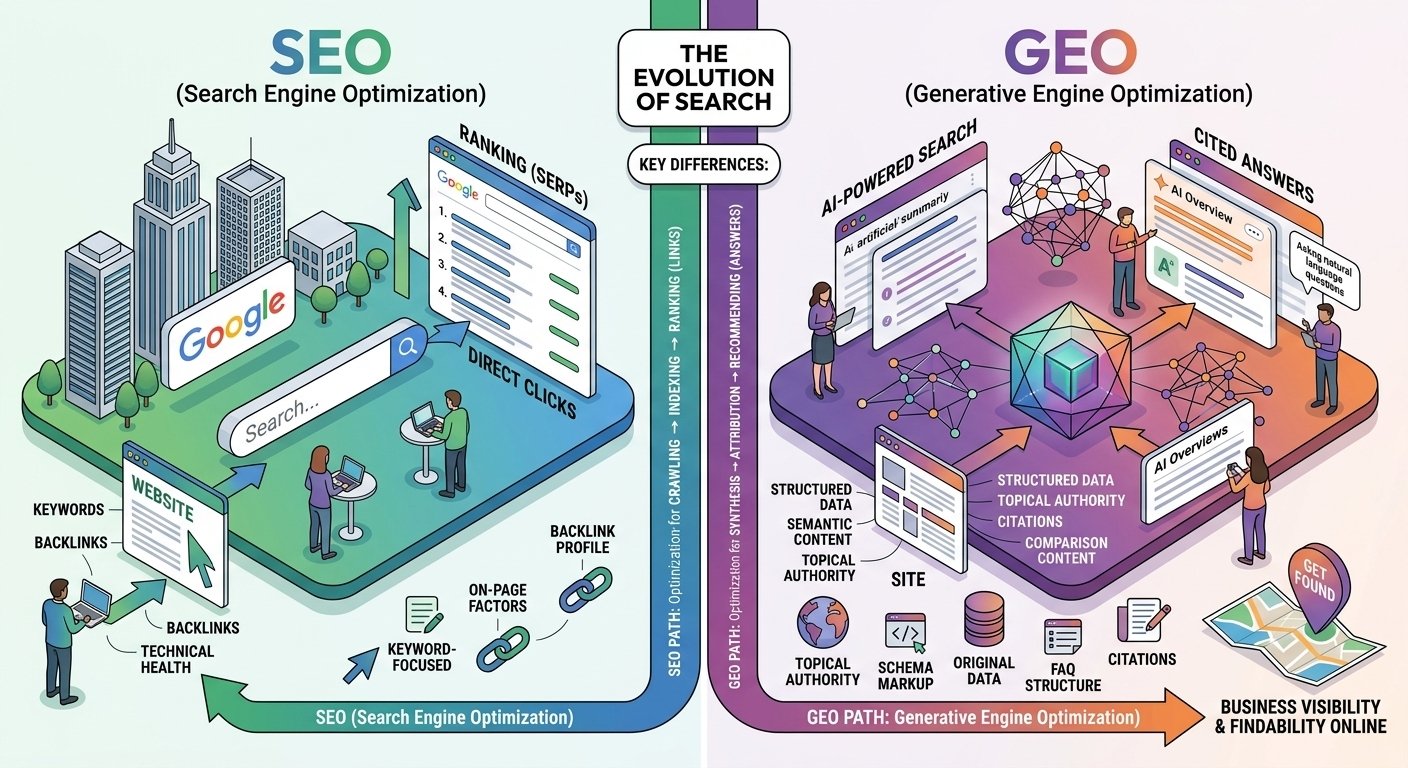
Search Just Changed. Is Your Website Ready?
For two decades, the goal of SEO was simple: rank on page one of Google. Today, that goal is no longer enough.
People are asking questions directly to ChatGPT, Google’s AI Overviews, and Perplexity, and getting complete answers without ever visiting a website. Search hasn’t disappeared. It has moved inside AI-generated conversations.
This shift has created a new discipline: GEO, or Generative Engine Optimization.
If you run a business and rely on organic search for leads, understanding GEO isn’t optional anymore. It’s the difference between being the source an AI recommends, and being invisible.
What Is GEO?
GEO is the practice of optimizing your website and content so that AI systems, like Google AI Overviews, ChatGPT, Gemini, and Perplexity, can understand, trust, and cite it when generating answers to user questions.
Traditional SEO optimizes for rankings. GEO optimizes for citations.
The goal isn’t just to appear on a results page. It’s to be the source an AI pulls from when it writes its answer, and ideally, the source it links back to.
Why GEO Matters Right Now
A few numbers explain why this shift is happening so fast:
- Roughly a third of Google searches in the US now trigger an AI Overview instead of traditional results.
- Over 80% of searches end without a click to any website, as AI increasingly answers the question directly on the results page.
- The vast majority of AI referral traffic currently comes through ChatGPT, ahead of other AI platforms.
- Nearly all CMOs surveyed say they are now investing in Answer Engine Optimization strategies.
- Only a small fraction of brands are actively tracking their visibility inside AI search results.
That last point matters most. Most businesses, and most of your competitors, aren’t paying attention to this yet. That gap is exactly where an early mover gains ground.
How GEO Is Different from Traditional SEO
| Traditional SEO | GEO |
|---|---|
| Optimizes for search engine rankings | Optimizes for AI-generated answers and citations |
| Success measured in click-through rate | Success measured in mentions, citations, and referral quality |
| Focuses on keywords and backlinks | Focuses on clarity, structure, and topical authority |
| One-size-fits-all results page | AI answers can be personalized per user |
GEO doesn’t replace SEO. It builds on it. A technically sound, well-structured site is still the foundation. GEO adds a new layer on top of that foundation.
How to Optimize Your Website for GEO
1. Structure content for direct answers
AI systems favor content that answers a question clearly and early, rather than burying the answer under long introductions. Lead with the answer, then explain the reasoning.
2. Use schema markup
Structured data such as FAQPage, HowTo, and Article schema helps AI systems understand what your content is and increases the likelihood it gets pulled into a generated summary.
3. Build real topical authority
AI models favor sources that are mentioned and referenced across the web, not just sites with backlinks. Digital PR, guest contributions, and consistent expert content matter more than ever.
4. Write in clear, extractable language
Short paragraphs, clear headings, and direct statements are easier for AI systems to parse and quote accurately. Dense, jargon-heavy writing gets skipped.
5. Keep technical SEO solid
None of this works if your site isn’t crawlable, fast, and properly indexed. GEO sits on top of good technical SEO, it doesn’t replace it.
6. Track your AI visibility
Start monitoring how often your brand shows up in ChatGPT, AI Overviews, and Perplexity answers for relevant queries. Most businesses skip this step entirely, which is exactly why doing it puts you ahead.
The Bottom Line
Search isn’t going away. It’s just moving. The businesses that adapt now, by structuring their content and authority for AI systems, will be the ones showing up when their customers ask a question, whether that question goes to Google or to ChatGPT.
The businesses that wait will find themselves optimized for a search experience fewer and fewer people are using.
Ready to Optimize Your Site for AI Search?
I help agencies and businesses get their websites ready for both traditional SEO and Generative Engine Optimization, from technical audits to schema implementation to content structure.
Get a free GEO and SEO audit of your website. Contact Now!
